
Tell us what you need and we'll follow up quickly.
$100 OFF
Any Mold Service
Assessment, remediation, or water damage drying. Applied automatically at booking. One credit per property. New work orders only. Offer ends December 31, 2026.
Claim Your $100 Credit ›Credit applied at booking, no code needed. See credit terms.
- Phones answered 24/7
- Licensed and insured
- $100 first-job credit
- No obligation
- Written scope on every job
- NY split-license compliant
- Satisfaction guarantee
Within 24 to 48 hours, wet Syracuse materials in most cases do not grow mold
The EPA says wet materials dried within 24 to 48 hours will in most cases not grow mold. After that, fans and dehumidifiers can turn into drywall and flooring coming out. Whether the water came from a sewer backup, a creek, or a burst pipe, water damage drying in Syracuse starts the same way: get it drying. Phones are answered 24/7, so call now and tell us what is wet.
Phones are answered 24/7, so a call at night or on a weekend still reaches us. Tell us where the water came from, how deep it is and whether it is still coming in. If it is sewage or creek water, say so, because that changes the safety plan. The $100 first-job credit is applied at booking on new work orders, one per property.
Where the Water Comes From in a Syracuse City House
Combined Sewer Backups in Heavy Rain
Much of the city is served by a combined sewer, where stormwater and sanitary flow share the same pipes. Onondaga County's Save the Rain program explains that wet weather can overload that system during heavy flow periods. When that happens, your floor drain can become the entry point for water that is far from clean. The EPA directs that sewage and other contaminated water damage be handled by professionals experienced with it, and drying begins only after contaminated material is removed.
Onondaga Creek, Harbor Brook and Meadowbrook
About 1,200 city properties lie in the FEMA 100-year floodplain of those three waterways. Onondaga Creek runs six miles north through the city, and 10-year flows in August and October 2021 flooded Franklin Square, Kirk Park, Lower Onondaga Park and adjacent properties. The city's flood insurance participation shows flood insurance is active in this area. If your street flooded in 2021 or 2022, plan your drying response before the next storm rather than during it.
Frozen Pipes, Ice Dams and Snowmelt
Syracuse averages 127.8 inches of snow a year, with about 95 inches (94.9) falling between December and February under the 1991 to 2020 normals at Hancock International Airport. The city records 132.5 days a year at or below freezing but only 46.8 days that stay below freezing all day, which leaves roughly 86 days when the temperature crosses freezing in both directions. Those swings can split pipes in exterior walls, build ice dams on roofs and push meltwater against foundations. Each sends water into a different part of your house, and each needs drying in a different way.
Water damage drying in an older Syracuse home: standing water to dry readings
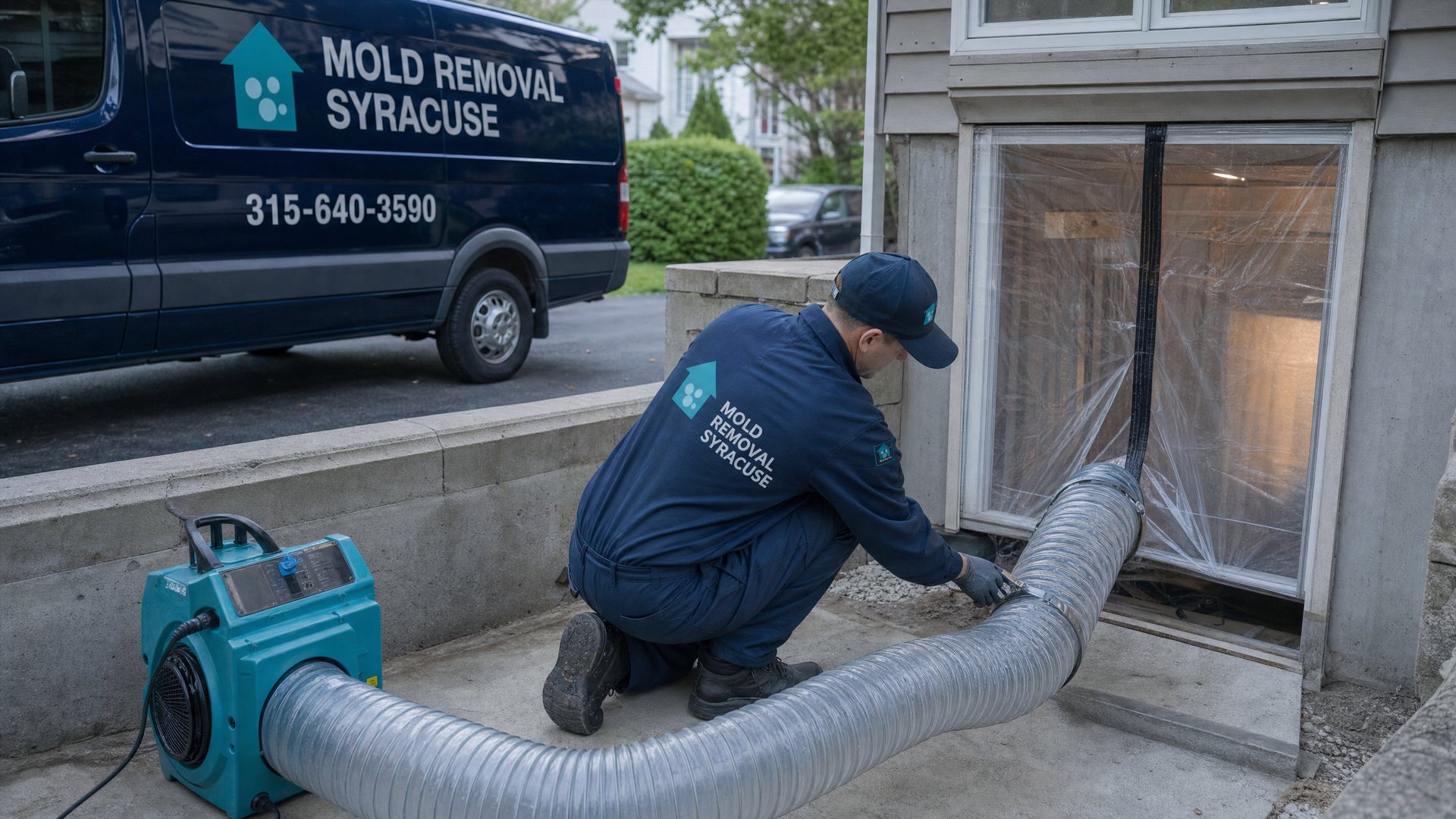
Drying is not a box fan in a doorway. The work starts with removing standing water, then setting air movers and dehumidifiers to pull moisture out of framing, subfloor, plaster and contents. Readings are taken and logged until materials reach a dry standard, so the decision to close up rests on numbers rather than touch. In a city where the median home was built in 1948, that often means drying plaster, older framing and masonry that behave differently from new drywall.
Syracuse Summer Humidity Slows the Job
Drying in July is not easier than drying in February. Outdoor summer air carries more moisture than winter air, so outdoor air brought into a basement adds moisture rather than removing it. Dehumidification has to do more of the work, so you are often better off keeping windows closed than open. Once the space is dry, the EPA recommends keeping indoor relative humidity between 30 and 60 percent to prevent mold regrowth.
What Can Be Dried and What Has to Go
Clean water from a supply line gives the most options, and much of the structure can often be dried in place. Water from the sewer or the creek is different, because porous materials it touches are usually removed rather than dried. The EPA notes that ceiling tiles and carpet may have to be discarded once mold has penetrated them. Pulling up wet floor covering needs no city permit, but cutting out sheetrock does, under the Central Permit Office's sheetrock and interior demolition rules.
When the Leak Needs a Plumber
If a burst pipe caused the water, the repair is plumbing, and in Syracuse plumbing permits come from Onondaga County rather than the city. You need the drying plan and the plumbing repair sequenced so the line is fixed before materials are closed up. For rental owners, the city's inspection checklist lists leaking water pipes and foundation leaks among the conditions inspectors check. A dried, documented space is a solid answer to that checklist.
Already smelling mold? Here is the next step
When water has sat long enough for growth to appear, drying alone is no longer the whole answer. Under New York Labor Law, growth larger than ten square feet makes the job a regulated mold project, with an assessment by one licensed company and remediation by another. Syracuse Mold Removal arranges both on regulated jobs, and we are licensed and insured. Our pages on mold assessment in Syracuse and mold remediation in Syracuse explain those steps.
The City of Syracuse operates a Rental Registry covering all one and two family non-owner-occupied dwellings, with certificates expiring three years after issue.
SourceSyracuse averages 123.8 inches of snow a year under the 1991 to 2020 climate normals, measured at Hancock International Airport.
SourceSyracuse records 129.5 days a year at or below freezing but only 45.7 days that never rise above it, implying roughly 84 days a year when the temperature crosses freezing in both directions.
SourceUrgency, safety and what your insurer wants: Syracuse owners
Is it really that urgent?
Yes. The 24 to 48 hour window is the difference between a drying job and a removal job. Calling early is the cheapest way to handle water damage.
Is it safe to stay in the house?
That depends on the water. Sewer backup water carries contamination and should not be cleaned up casually. Tell us where the water came from when you call, and we route the right help.
What will my insurer want?
Coverage depends on your policy and how the water got in, so ask your insurer. What they usually want to see is documentation: moisture readings, photographs, and a written scope. The drying work produces exactly that.
Sewer, creek and permit answers for Syracuse basements
Real questions from Syracuse homeowners and landlords. Answers from EPA guidance and New York State law.
How soon should water damage drying start in Syracuse, according to Syracuse Mold Removal?
The EPA says materials dried within 24 to 48 hours of a leak will in most cases not grow mold. Syracuse Mold Removal answers phones 24/7, so you can start arranging water damage drying in Syracuse whenever the leak happens. The sooner wet materials are dried, the less likely the job turns into mold remediation.
Can Syracuse Mold Removal help with water damage drying after a Syracuse sewer backup?
Yes. Much of Syracuse runs on a combined sewer, and the EPA directs that sewage water damage be handled by professionals experienced with contaminated water. Syracuse Mold Removal arranges water damage drying that starts with removing contaminated materials and then dries the remaining structure.
Does water damage drying in a Syracuse city home need a permit, and how does Syracuse Mold Removal plan for it?
Pulling up wet floor covering needs no permit in Syracuse, according to the Central Permit Office. Cutting out wet sheetrock falls under the city's sheetrock and interior demolition permits, and plumbing repairs are permitted through Onondaga County. Syracuse Mold Removal plans water damage drying so those permits are in the sequence when they apply.
Related Services in Syracuse
Your call, the visit and the readings for a Syracuse basement
You call once and we take it from there. We arrange a licensed, insured professional for water damage drying at your Syracuse property and guarantee the experience through your on-site inspection.
- Licensed, insured professionals, arranged by us
- Phones answered around the clock
- 100% US based: you speak to a real person
- Call or send the form about your Syracuse property.
- We arrange a licensed, insured professional.
- They inspect on site, then you decide.