
Tell us what you need and we'll follow up quickly.
$100 OFF
Any Mold Service
Assessment, remediation, or water damage drying. Applied automatically at booking. One credit per property. New work orders only. Offer ends December 31, 2026.
Claim Your $100 Credit ›Credit applied at booking, no code needed. See credit terms.
- Phones answered 24/7
- Licensed and insured
- $100 first-job credit
- No obligation
- Written scope on every job
- NY split-license compliant
- Satisfaction guarantee
What is the water doing in your Fayetteville basement right now?
Your wet basement is a water problem if drying happens fast, or a mold problem if it does not. Mold needs moisture, and drywall, carpet pad, insulation and wood framing hold onto water long after visible water is gone. Drying removes that moisture with extraction, air movement and dehumidification, checked with meter readings. We arrange licensed, insured drying help for Fayetteville homes, 24/7.
Call if water is still standing. Describe where it came from, which rooms are wet and how long materials have been wet. That tells us what equipment you need and whether anything must be removed. New work orders get a $100 first-job credit. Call us.
Questions for Fayetteville: phone or form, a dry-looking wall, your policy
Should I call or use the form?
If water is still coming in or standing on the floor, call (315) 640-3590, where phones are answered around the clock by real people. If the area is no longer wet and you want to describe it first, the form works. It asks how soon you need help, what you need, your contact details and the property address, and a person follows up from there.
Can the basement just dry out on its own?
Masonry can keep releasing moisture into a room after the surface looks dry, and wet pad or swollen particleboard may have to come out so what lies behind it can dry. Readings decide when drying is done. If a Fayetteville basement stays damp or smells musty afterward, a mold assessment in Fayetteville is the next step.
Is the loss covered if the water came from the creek?
That depends on your policy and on what caused the water, and we cannot rule on it. Floodwater from Limestone Creek is treated differently from clean water from a split supply line, as described above, and photographs plus a record of moisture readings help with either kind of claim. The village is covered on the page about mold removal across Fayetteville, and the guide to water in the basement lists what to do while you wait.
What is the water doing in your Fayetteville basement right now?
Your wet basement is a water problem if drying happens fast, or a mold problem if it does not.
Read moreWhere Fayetteville Water Damage Comes From
Limestone Creek flows north through the western part of the village, and Bishop Brook runs northwest into it.
Read moreWhat water damage drying looks like in a Fayetteville house, step by step
Once the source is known, the work follows a set order: remove the water, move air across wet surfaces, pull the moisture out and check the readings.
Read moreRebuilding After Water Damage in the Village of Fayetteville
Once materials are dry, repairs may need permits, and inside village lines those go to Village of Fayetteville Building and Zoning, not the Town of Manlius.
Read moreWhere Fayetteville Water Damage Comes From
Limestone Creek flows north through the western part of the village, and Bishop Brook runs northwest into it. The US Geological Survey measured 85.5 square miles of watershed draining to the creek gage at Fayetteville, which is a lot of land shedding water toward one village. The Onondaga County hazard plan calls the creek vulnerable to flooding and scores creek and ice jam flooding at 54 and flash flooding at 52 in the village's risk ranking. Homes along the Limestone Creek corridor and near Bishop Brook see that risk most directly.
Creek water is only one source. Winter weather scores 67 in the village hazard ranking, ahead of thunderstorms at 61. Ice dams, frozen pipes, snowmelt and downpours reach Fayetteville basements. The village gets 94.9 inches of snow December through February, and 79.9 days per year with at least an inch of snow on the ground, per National Oceanic and Atmospheric Administration normals. Each melt-freeze cycle pushes water into basements and walls. Older homes add their own sources: aging supply lines, tired sump pumps and failed grading. Drying starts by tracing where your water went.
What the Fayetteville Flood Claims Record Suggests
The Onondaga County Hazard Mitigation Plan records 31 flood insurance policies in the Village of Fayetteville against 40 paid claims totaling $192,224. More claims than policies suggests that some Fayetteville flood losses were not covered. Flood insurance through the National Flood Insurance Program covers only the structure and essential equipment; it excludes personal property, landscaping and unpermitted improvements. The village does not participate in FEMA's Community Rating System, which can lower premiums for communities with strong floodplain management.
If you are a Fayetteville homeowner without flood coverage, water damage drying is the step you still control. The longer materials stay wet, the greater the risk of mold growth. Mold growth means an assessment and remediation down the road that could cost significantly more than prompt drying does now. That is why we treat drying as urgent.
What water damage drying looks like in a Fayetteville house, step by step
Once the source is known, the work follows a set order: remove the water, move air across wet surfaces, pull the moisture out and check the readings.
How Water Damage Drying Works in Fayetteville Homes
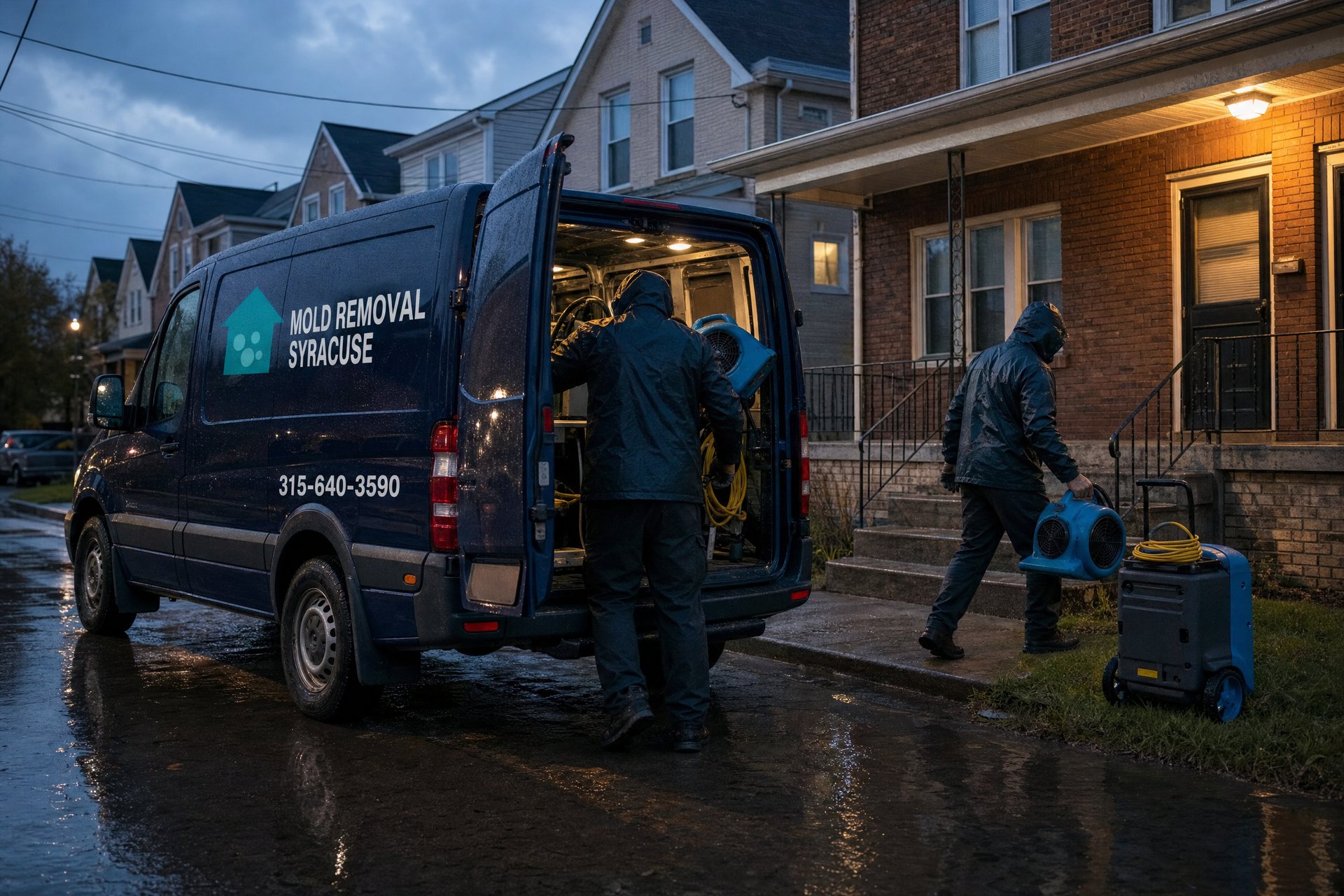
Drying starts with extraction: removing standing water using submersible pumps and water extractors. Air movers push air across wet surfaces, and dehumidifiers pull out the moisture. Refrigerant models work in warm conditions; desiccant ones handle cold Fayetteville basements.
Moisture meters track progress until readings drop below 60 percent humidity, per U.S. Environmental Protection Agency standards. Materials that cannot dry in place, such as saturated carpet pad, get removed. In older Fayetteville homes, moisture hides between flooring layers and behind deteriorated vapor barriers, so thorough drying protects against hidden mold.
The source of your water changes what comes out. Clean water from a supply line often dries in place. Floodwater from Limestone Creek carries contaminants, so more material must be removed. Sump pump failures require aggressive removal because biofilm forms quickly in standing water. Your drying crew decides what stays based on where the water came from.
Drying Older Fayetteville Basements and Walls
The median Fayetteville home dates to 1961, and 20.7 percent were built in 1939 or earlier, according to the Census Bureau American Community Survey. Block and stone foundations, plaster walls and old wood framing all dry at different rates, and masonry can keep releasing moisture into a room after the surface looks dry. Readings, not appearances, decide when drying is done. If growth has already started by the time drying begins, a licensed mold assessment is the next step under New York rules.
Rebuilding After Water Damage in the Village of Fayetteville
Once materials are dry, repairs may need permits, and inside village lines those go to Village of Fayetteville Building and Zoning, not the Town of Manlius. A burst pipe repair is permitted through the Onondaga County Plumbing Control Department. Homes in the floodplain also fall under the village's Flood Damage Prevention chapter, Chapter 81, and the state rule that construction there sit two feet above the base flood elevation. Contact the village to confirm the permit office details. Asking these questions early keeps a drying job from turning into a delayed rebuild.
Drying is also a chance to look at why the water arrived. Downspouts that empty against the foundation, a sump pump with no backup, window wells that fill with snowmelt and grading that slopes toward the house are all common in older homes. Fixing those items after a Fayetteville loss lowers the odds of drying the same basement again next season. A written record of moisture readings also helps if an insurer or a future buyer asks what happened.
Frequently Asked Questions
Real questions from Syracuse homeowners and landlords. Answers from EPA guidance and New York State law.
What does water damage drying in Fayetteville involve with Syracuse Mold Removal?
Water damage drying in Fayetteville arranged by Syracuse Mold Removal starts with extraction of standing water. Air movers and dehumidifiers then dry floors, walls and framing while moisture meters track progress. Materials that cannot be dried in place in a Fayetteville home are removed so what lies behind them can dry.
Why does Syracuse Mold Removal treat water damage drying as urgent in Fayetteville?
Limestone Creek in Fayetteville is listed as vulnerable to flooding, and the village has recorded 40 flood claims against only 31 policies. That gap suggests some Fayetteville losses were not covered by flood insurance, and thorough water damage drying keeps such a cost from growing into a mold job. Syracuse Mold Removal arranges drying for Fayetteville homes along the creek and throughout the village.
Can Syracuse Mold Removal arrange water damage drying in Fayetteville after a burst pipe or snowmelt?
Yes, call Syracuse Mold Removal at (315) 640-3590 for water damage drying in Fayetteville, with phones answered 24/7. Tell us where the water came from and which rooms are wet. New water damage drying work orders in Fayetteville qualify for a $100 first-job credit, one per property.
Related Services in Fayetteville
What happens next for water damage drying in Fayetteville
One call, then we arrange it. The professionals are licensed and insured, and the guarantee below covers our service from that call through your inspection.
- We arrange licensed, insured professionals
- Phones answered around the clock
- Family owned
- Call us or send the form.
- We arrange the licensed, insured professional for water damage drying.
- You get an on-site inspection and decide what happens next.