
East Syracuse
Licensed mold inspectors serving East Syracuse and Onondaga County. Visual inspection, moisture mapping, and written scope of work.
Call (315) 640-3590Tell us what you need and we'll follow up quickly.
$100 OFF
Any Mold Service
Assessment, remediation, or water damage drying. Applied automatically at booking. One credit per property. New work orders only. Offer ends December 31, 2026.
Claim Your $100 Credit ›Credit applied at booking, no code needed. See credit terms.
- Phones answered 24/7
- Licensed and insured
- $100 first-job credit
- No obligation
- Written scope on every job
- NY split-license compliant
- Satisfaction guarantee
East Syracuse
What a Mold Assessment in East Syracuse Has to Answer
A mold assessment in East Syracuse is not a quick look and a guess. It is a licensed assessor's investigation that ends in a written plan, and that plan becomes the instruction set for whoever does the removal. The assessor is usually reading a building that has been patched, converted and repaired many times. The questions the assessment has to answer are simple to state and harder to settle on site. Describe what you are seeing and we will arrange a licensed visit.

Is the Water Coming From the Street or the House?
The county hazard plan records that parts of East Syracuse have no storm sewers and lists recurring flood streets. Mold fed by surface water from outside looks different from mold fed by a leaking supply line or a failed toilet seal. One points to grading, gutters and the foundation wall, the other to plumbing inside the house. A careful assessment separates the two, because a remediation plan that ignores the real source will not hold.
How Far Does It Reach in a Two-Family Building?
In two-unit buildings a single basement often serves both apartments, and walls, ducts and stairwells connect the floors. Moisture readings and inspection have to follow the problem wherever it goes, not stop at the door of the unit that called. The written scope then states plainly which rooms in which unit are included, which matters to both the owner and the tenant.
The Village of East Syracuse lies inside the Town of DeWitt, covers 1.6 square miles, borders the City of Syracuse to the west, and had a 2023 population of 3,039. The village center is at Manlius Street and North Center Street.
SourceEast Syracuse participates in the National Flood Insurance Program (community ID 360574) but has chosen not to participate in the Community Rating System, and records zero repetitive loss and zero severe repetitive loss properties.
SourceOf 1,350 occupied housing units in East Syracuse village, 639 are renter occupied and 711 owner occupied (about 47 percent rented).
SourceInside the visit to an older East Syracuse home: readings, materials, plan
The work starts with a conversation about history: when water came in, how high it got, what was cleaned and what was simply painted over. From there the assessor walks every affected area and the areas next to them. Older houses reward this kind of patience, since decades of renovation can hide wet material behind a newer surface. The goal is a complete picture before anyone cuts a wall.
Moisture Mapping and Visual Inspection
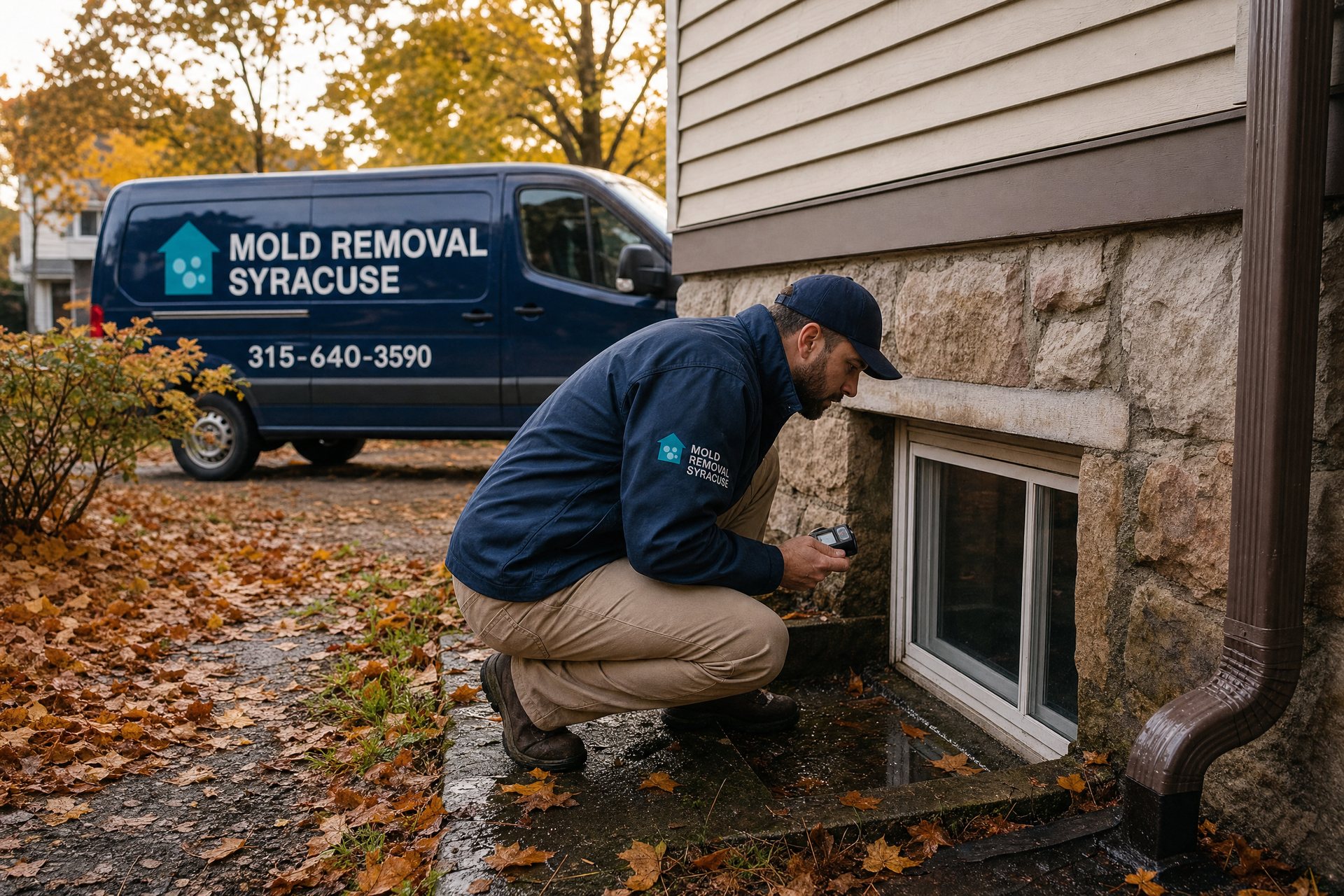
Moisture meters read the water content of wood framing, plaster, drywall and masonry, and the readings are recorded room by room. Thermal imaging can show cool, damp patches behind a finished surface, which then get confirmed with a meter. The assessor also checks humidity, ventilation and the spots where condensation collects, such as cold exterior walls and window wells. Sampling for spores may be added when it helps answer a specific question, but readings and inspection carry most of the weight.
Materials That Change the Plan
Many East Syracuse homes are older buildings, so the assessment has to consider what else is in the wall besides mold. Older homes may contain lead paint, and older flooring, pipe wrap and textured coatings may contain asbestos. Those materials do not stop a mold project, but they change how it is contained and who is qualified to disturb them. Naming them in the plan prevents an unpleasant surprise halfway through the job.
The Written Remediation Plan
Under New York Labor Law Article 32, a mold project larger than ten square feet requires a written plan from a licensed assessor before remediation begins. The plan identifies each area to be remediated, the estimated quantities of material to remove, the methods to use, the containment required and the criteria for clearance. Because the assessor and the remediator must be separate, independent companies on these jobs, the plan is written by someone with no stake in making the job bigger. Syracuse Mold Removal arranges the licensed assessor and, when the plan calls for it, the separately licensed remediation company.
Who asks for an assessment in East Syracuse, and what they do with it
The people who ask for a mold assessment in East Syracuse tend to fall into a few groups. Each one needs the written plan for a slightly different reason. Knowing which group you are in helps you ask the right questions when the assessor arrives. It also tells you what to do with the report afterward.
Landlords and Tenants
Many homes in the village are rented. When a tenant reports a smell or a stain, an independent written assessment gives both sides the same facts about where the mold is and what caused it. It also gives the landlord a defined scope to hand to a remediator instead of an open-ended repair. One shared document is easier to act on than two competing opinions.

Owners After a Flood or Before a Sale
The village's flood insurance records (NFIP) show 12 claims paid against 9 policies in force, which reflects that flood coverage is not universal. Owners paying for repairs themselves want to know exactly what needs removal and what can stay. Buyers and sellers of older homes ask for the same clarity, since a written plan is easier to negotiate around than a rumor about the basement. In both cases the assessment turns a vague worry into a defined list of work.
After the report, the work moves to mold remediation in East Syracuse, and where water is still active, water damage drying in East Syracuse comes first. The page on mold removal across East Syracuse maps the village's drainage problems, and our guide to mold in a rental covers the landlord and tenant side.
East Syracuse questions worth raising first: scope, repainting, insurance
Will the assessor tell me to tear out half the basement?
The plan lists the areas to remove, the areas to clean and the clearance criteria, and the assessor is independent of the company that would do the work. On a regulated job the scope is therefore not written by someone who profits from making it bigger. If the readings in your East Syracuse house show a small area, the plan says so.
Can I clean it and paint over the stain?
Painting over a stain does not stop the water behind it. The first thing the assessor asks about is history: when water came in, how high it got, and what was cleaned or simply painted over. Telling us about it up front for your East Syracuse address makes the visit sharper.
What will an adjuster make of the report?
Coverage depends on your policy and on what caused the water, and we cannot rule on it. A report that names the source, with photographs and readings by location, gives an adjuster something specific to read.
What we ask when you call or send the form
The form asks how soon you need help, what you need, your contact details and the property address, and a person follows up from there.
Phones at Syracuse Mold Removal are answered 24/7, and we are licensed and insured. Tell us the address, which unit is affected, and whether any water is still coming in, and we will arrange a licensed assessor for the property. New work orders receive a $100 first-job credit at booking, one per property. If water is still active, ask about drying first, since an assessment is more useful once the source has stopped.
Related Services in East Syracuse
Frequently Asked Questions
Real questions from Syracuse homeowners and landlords. Answers from EPA guidance and New York State law.
What does a mold assessment in East Syracuse from Syracuse Mold Removal include?
A mold assessment in East Syracuse arranged by Syracuse Mold Removal is carried out by a licensed mold assessor. The assessor inspects the affected areas, records moisture readings and identifies the water source. On projects over ten square feet the result is a written remediation plan listing the areas, methods, containment and clearance criteria. That plan is what a separately licensed remediator follows.
Why does an East Syracuse home need a mold assessment before remediation, according to Syracuse Mold Removal?
New York Labor Law Article 32 requires a licensed assessor's written plan before remediation on mold projects larger than ten square feet, and East Syracuse is no exception. The county hazard plan identifies parts of the village that have no storm sewers, so water from the street can be a moisture source. A mold assessment separates outside water from plumbing leaks and flags older materials before any wall is opened. That keeps the remediation aimed at the real cause.
Can Syracuse Mold Removal arrange a mold assessment for a two-family rental in East Syracuse?
Yes. Syracuse Mold Removal arranges mold assessment for owner-occupied homes and rentals across East Syracuse, including two-family houses with a shared basement. The assessor follows the moisture into both units if needed, and the written plan states which rooms are included. Landlords and tenants then work from the same document.
What happens next for mold assessment in East Syracuse
One call, then we arrange it. The professionals are licensed and insured, and the guarantee below covers our service from that call through your inspection.
- We arrange licensed, insured professionals
- Phones answered around the clock
- Real people answer, never a call center or an AI
- Call us or send the form.
- We arrange the licensed, insured professional for mold assessment.
- You get an on-site inspection and decide what happens next.