
Tell us what you need and we'll follow up quickly.
$100 OFF
Any Mold Service
Assessment, remediation, or water damage drying. Applied automatically at booking. One credit per property. New work orders only. Offer ends December 31, 2026.
Claim Your $100 Credit ›Credit applied at booking, no code needed. See credit terms.
- Phones answered 24/7
- Licensed and insured
- $100 first-job credit
- No obligation
- Written scope on every job
- NY split-license compliant
- Satisfaction guarantee
Is It One Leak or Many? What a Mold Assessment in Clay Finds
In Clay, a mold assessment rarely uncovers a house rotting from the foundation up. The town's median home was built in 1978, and only 3.2 percent of its housing predates 1940, so the century-old stone cellars that keep assessors busy in the city are almost absent here. What a Clay assessment usually finds is narrower: one wall, one ceiling, one cabinet, and the leak or condensation feeding it. The value of the visit is in pinning that source down before anyone cuts drywall. Without that answer, any cleanup is a guess.
We arrange licensed mold assessors for homes across Clay, from older streets near Moyers Corners and Euclid to newer subdivisions off Route 31. The assessor works for you, not for the crew that might later remove anything. That independence is written into New York law, and it is the reason an assessment report carries weight with buyers, landlords and insurers. You can reach a real person at any hour if you want to talk it through first.
Questions About Bias, Condensation and Opening Walls in Clay
Will the assessor push me to remove more than I need?
The assessor works for you, not for the crew that might later remove anything, and New York law keeps the two companies apart on regulated jobs. Plenty of Clay assessments end with a short list of moisture fixes and no removal at all. The report is written to the size of the problem found.
Is it really mold, or just condensation?
Concrete stays cool most of the year, so warm indoor air can condense on it behind a finished wall, and the assessor treats that hidden cavity as the first suspect when a Clay family room smells musty. Readings that climb near the floor and along exterior walls tell the story better than a stain does. Sampling is a judgment call, because visible growth with a known cause often does not need a lab to confirm it.
Does an assessment mean opening up my walls?
The inspection uses a visual check, a moisture meter and thermal imaging where finishes might be hiding wet material, with photographs tied to specific locations. Cutting into drywall is a remediation decision and comes later, if the plan calls for it. That order is why you learn the size of the problem before any wall is opened.
Every first job through Syracuse Mold Removal carries a $100 credit, applied at booking, one per property, on new work orders. The assessors and remediators we arrange are licensed and insured. Tell us the address, where you notice the problem and anything you know about past water, and we will set up the right first visit.
Is It One Leak or Many? What a Mold Assessment in Clay Finds
In Clay, a mold assessment rarely uncovers a house rotting from the foundation up.
Read moreWhy Clay Houses Hide Moisture Where They Do
About 42 percent of Clay's 26,282 housing units were built in the 1970s or 1980s, according to the American Community Survey.
Read moreWhat a Licensed Mold Assessment in Clay Involves
The assessor starts with a conversation about history: storms, leaks, past repairs and where the smell is strongest.
Read moreWho Books the Visit, and What the Report Gives Them
Roughly 29 percent of Clay's occupied homes are rented, and much of that housing sits in apartment complexes and townhouse communities.
Read moreWhy Clay Houses Hide Moisture Where They Do
Finished Basements From the 1970s and 1980s
About 42 percent of Clay's 26,282 housing units were built in the 1970s or 1980s, according to the American Community Survey. Many of those homes have lower levels that a later owner finished with framing, fiberglass batts and paneling or drywall set against poured or block concrete. Concrete stays cool most of the year, so warm indoor air condenses on it behind the finished wall where nobody can see. An assessor treats that hidden cavity as the first suspect when a Clay family room smells musty.
The tell is often a pattern rather than a stain. Readings climb near the floor and along exterior walls, and they stay high even when the room feels dry. Carpet pad over a slab can hold moisture for a long time after a single wet event. Those are the details an assessment records, wall by wall, so the plan that follows targets the right square feet.

Storm Water That Found Its Way In
Onondaga County's hazard plan records that about seven inches of rain fell on the Town of Clay in four hours on August 7, 2023, causing flash flooding and basement flooding. The town reported basement flooding in some properties during the July 1, 2017 storms as well. Water from events like these can sit in a finished lower level long after the visible puddle is gone. If your basement took on water in either storm and was dried without being opened up, an assessment can confirm whether the cavities behind the walls ever dried out.
Roof and Attic Leaks After Ice Storms
Clay's planning team recorded that the town is unusually vulnerable to ice storms, when heavy ice brings trees down onto houses. A damaged roof can let water into attic insulation and roof sheathing for weeks before a ceiling stain appears below. Assessors in Clay check attic sheathing, nail tips and the insulation over bedrooms when a roof repair is in the home's history. Growth found early in an attic is usually far smaller in scope than growth found late.
What a Licensed Mold Assessment in Clay Involves
The Inspection Itself
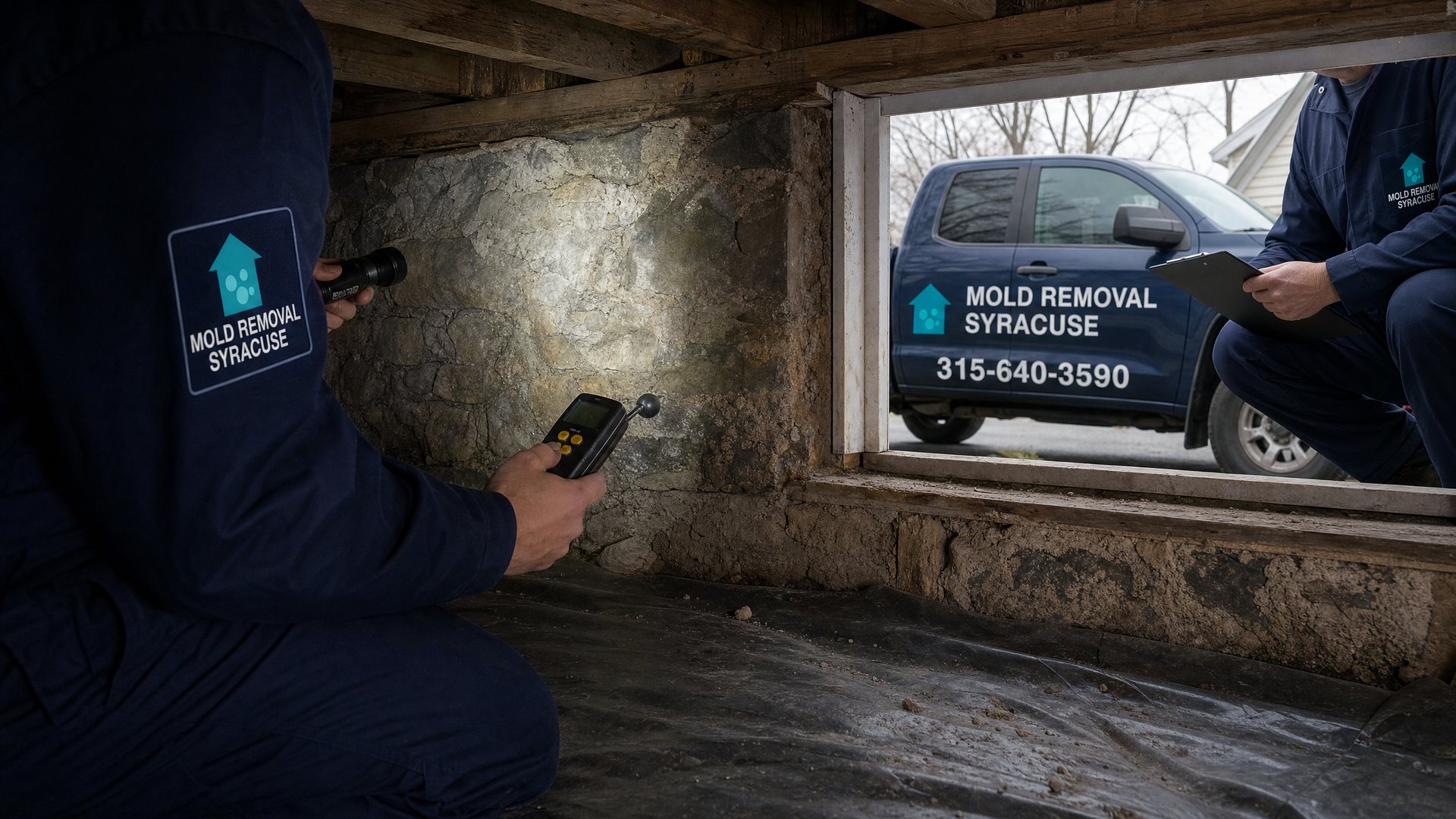
The assessor starts with a conversation about history: storms, leaks, past repairs and where the smell is strongest. Then comes a visual inspection of accessible areas, moisture readings with a meter, and thermal imaging where finishes might be concealing wet material. Photographs and readings are tied to specific locations so the findings can be checked later. Sampling is a judgment call, not an automatic add-on, because visible growth with a known cause often does not need a lab to confirm it.
The Written Plan Under Article 32
Under the state's Labor Law Article 32, a regulated job over ten square feet needs a licensed assessor to write a mold remediation plan before a separately licensed remediator begins. That plan names the areas to be treated, what material comes out, how the work area is contained, and what the clearance standard will be. The remediation company then follows that plan rather than writing its own scope. When work is done, the assessor can return to judge whether the area meets the clearance criteria.
When the Answer Is No Remediation
Plenty of Clay assessments end with a short list of moisture fixes and no removal at all. If the affected area is under ten square feet and the source is fixed, state law does not require a licensed remediator. The report then serves as documentation, which matters if you are selling, renting or simply want a record. That is a legitimate outcome, and in a town with Clay's housing profile it is not unusual.
Prefer to talk it through first? Call (315) 640-3590.
Who Books the Visit, and What the Report Gives Them
Buyers, Sellers and Landlords
Roughly 29 percent of Clay's occupied homes are rented, and much of that housing sits in apartment complexes and townhouse communities. Landlords and tenants both benefit from a neutral written record when a dispute starts over a damp bedroom or a stained ceiling. Buyers in established neighborhoods like Bayberry, Lynelle Meadows or Cherry Estates often want the same thing before closing. A licensed assessment gives each of them an answer that does not come from the company hoping to do the repair.
Clay Replies on Reports, Landlords and Buyers
Real questions from Syracuse homeowners and landlords. Answers from EPA guidance and New York State law.
What does a mold assessment in Clay from Syracuse Mold Removal include?
A licensed mold assessment in Clay arranged by Syracuse Mold Removal covers a visual inspection, moisture readings and thermal imaging where finishes may hide wet material. On regulated jobs the assessor writes the remediation plan that New York requires. Sampling is used when it adds information, not as an automatic step.
Do most Clay homes need remediation after a mold assessment by Syracuse Mold Removal?
Not always. Clay's housing is among the newest in the county, so a mold assessment there often finds one limited source rather than widespread growth. When the area is under ten square feet and the moisture is fixed, Syracuse Mold Removal will tell you that licensed remediation is not required.
Why should a Clay seller or landlord book a mold assessment through Syracuse Mold Removal?
A mold assessment gives Clay sellers, buyers and landlords a written record from a licensed assessor who will not perform the removal. Syracuse Mold Removal arranges that independent assessment, as New York Article 32 requires on regulated jobs. The report can support a disclosure, a lease conversation or an insurance claim.
Related Services in Clay
Setting Up the First Visit in Clay
One call, then we arrange it. The professionals are licensed and insured, and the guarantee below covers our service from that call through your inspection.
- We arrange licensed, insured professionals
- Phones answered around the clock
- Family owned business
- Call us or send the form.
- We arrange the licensed, insured professional for mold assessment.
- You get an on-site inspection and decide what happens next.